
JavaScript Primitives
A JavaScript variable can hold 8 types of data.
7 Primitive types or an Object type.
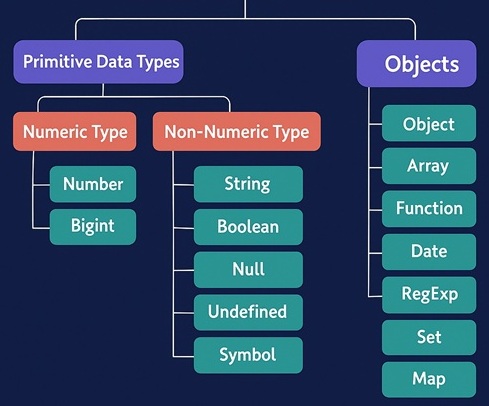
Examples
// Number
let length = 16;
let weight = 7.5;
// BigInt
let x = 1234567890123456789012345n;
let y = BigInt(1234567890123456789012345)
// Strings
let color = "Yellow";
let lastName = "Johnson";
// Boolean
let x = true;
let y = false;
// Undefined
let x;
let y;
// Null
let x = null;
let y = null;
// Symbol
const x = Symbol();
const y = Symbol();
JavaScript Strings
A string (or a text string) is a series of characters like "John Doe".
Strings are written with quotes. You can use single or double quotes:
Example
// Using double quotes:
let carName1 = "Volvo XC60";
// Using single quotes:
let carName2 = 'Volvo XC60';
Try
it Yourself »
You can use quotes inside a string, as long as they don't match the quotes surrounding the string:
Example
// Single quote inside double quotes:
let answer1 = "It's alright";
// Single quotes inside double quotes:
let answer2 = "He is called 'Johnny'";
// Double quotes inside single quotes:
let answer3 = 'He is called "Johnny"';
Try
it Yourself »JavaScript Numbers
All JavaScript numbers are stored as decimal numbers (floating point).
Numbers can be written with, or without decimals:
Exponential Notation
Extra large or extra small numbers can be written with scientific (exponential) notation:
Number Types
Most programming languages have many number types:
Whole numbers (integers):
byte (8-bit), short (16-bit), int (32-bit), long (64-bit)
Real numbers (floating-point):
float (32-bit), double (64-bit).
Javascript numbers are always double (64-bit floating point).
Learn More:
JavaScript BigInt
All JavaScript numbers are stored in a 64-bit floating-point format.
JavaScript BigInt is a new datatype (ES2020) that can be used to store integer values that are too big to be represented by a normal JavaScript Number.
Learn More:
JavaScript Booleans
Booleans can only have two values: true or false.
Example
let x = 5;
let y = 5;
let z = 6;
(x == y)
// Returns true
(x == z) // Returns
false
Try it Yourself »Booleans are often used in conditional testing.
Learn More:
The typeof Operator
You can use the JavaScript typeof operator to find the type
of a JavaScript variable.
The typeof operator returns the type of a variable or an expression:
Example
typeof "" // Returns
"string"
typeof "John" // Returns
"string"
typeof "John Doe" // Returns
"string"
Try it Yourself »
Example
typeof 0 // Returns
"number"
typeof 314 // Returns
"number"
typeof 3.14 // Returns
"number"
typeof (3) // Returns
"number"
typeof (3 + 4) // Returns
"number"
Try it Yourself »
Learn More:
Undefined
In JavaScript, a variable without a value, has the value undefined.
The type is also undefined.
Any variable can be emptied, by setting the value to undefined.
The type will also be undefined.
Empty Values
An empty value has nothing to do with undefined.
An empty string has both a legal value and a type.
Datatype null
In JavaScript, a variable or an expression can obtain the datatype null in several ways.
A function can return null or a variable can be assigned the null value:
The typeof operator returns object for null.
This is a historical quirk in JavaScript and does not indicate that null is an object.
The strict equality operator (===) compares both the value and the type of the operands.
It returns true only if both the operands values and types are
null.
The loose equality operator (==) also returns true
for a null value,
but it also returns true if the value is undefined.
Using == is not recommended when checking for null.